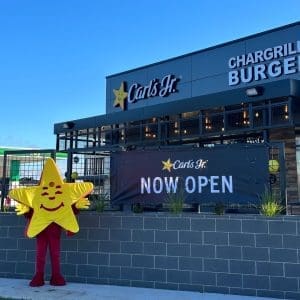
Carl’s Jr. has quietly become one of the more interesting stories in Australian fast food.
After a rocky 2024 — when the brand’s master franchisee went into administration and headlines suggested Carl’s Jr. was packing up and leaving — the US parent stepped in directly, steadied the ship, and emerged on the other side with a leaner, more focused operation.
With over 3,900 restaurants worldwide, they’re now doubling down on what made them different in the first place: real chargrilled burgers, premium ingredients, and a no-compromise approach to quality.
The Carl’s Jr. Franchise Difference: Chargrilled Authority
Most fast-food chains cook their burgers on flat-top griddles. Carl’s Jr. doesn’t.
The open-flame chargrilling process is central to everything they do — it’s what gives the beef that slightly smoky, caramelised crust you don’t get anywhere else at this price point.
Pair that with premium Angus beef and hand-breaded chicken tenders, and you’ve got something that genuinely sits between a quick-service restaurant and a proper burger bar.
CEO Insight: Gaven Needham, General Manager Asia Pacific, CKE Restaurants
“The headlines in 2024 suggested the brand was leaving Australia, which was incorrect. It was a structural shift that allowed us to step in directly. In 2026, we are not looking for a new master franchisee — we’ve built a dedicated Melbourne-based team to support our partners directly. We’re 100% committed to the Australian market and are actively exploring smaller, optimised restaurant formats to thrive in local trade zones.” (Source: QSR Media / AACS 2025)
The 2026 Roadmap for Carl’s Jr. Australia Franchise : Stability and Targeted Growth
When CJ’s QSR Group went into administration in 2024, it forced a hard reset. Locations that weren’t performing closed. The ones that were worth keeping got new operators.
It was painful in the short term, but the result is a network that’s actually built on solid ground.
- Direct Support Model: CKE Restaurants — the US parent — now runs its Australian operations from a new Melbourne headquarters. There’s no middleman anymore. Franchisees deal directly with the brand owners, which means faster decision-making, better supply chain terms, and access to whatever CKE is developing globally.
- The Comeback: After the 2024 restructure, 29 of the strongest restaurants moved to new operators relatively quickly. What stood out was how quickly staff and customers returned — a sign that the brand itself had never really lost its appeal, even when the business structure around it had collapsed (Source: Convenience & Impulse Retailing).
- Regional Expansion: Growth in 2026 is deliberate rather than aggressive. Five new restaurants are in the pipeline over the next 12 to 18 months, with a focus on regional hubs and parts of Western Australia and Queensland that don’t yet have a strong premium burger option.
- Store Design: Carl’s Jr. has been quietly rethinking what a fast food restaurant needs to look like. Their “Store of the Future” program is less about flashy tech and more about making the format work harder — digitally and physically.
- Flexible Footprints: The old model of needing a big standalone building is being phased out. In 2026, the brand is actively pursuing smaller formats — food courts, urban inline sites, even convenience store partnerships — which open up locations that simply weren’t viable before.
- Digital: The brand is testing a white-label delivery option inside its own app — the goal being to cut the commission fees that Uber Eats and DoorDash take from every order. They’re also using an AI-powered site selection tool to help prospective franchisees identify locations with the strongest return potential before they sign anything (Source: Franchise Information for Carl’s Jr.).
- Franchisee Training and Support: New operators complete a 12-week Franchise Management Training Program, conducted at a certified training restaurant. It covers the full range you’d expect — food quality, staff management, customer service, inventory, health and safety — but also digs into local marketing and digital systems, where many franchisees need the most help.
After opening, support doesn’t disappear.
The Melbourne team visits regularly, there’s a direct hotline for day-to-day questions, and franchisees get access to whatever CKE is rolling out globally. The aim is consistent quality across every site, not just at launch.
Franchise Investment Snapshot (2026)
Getting into Carl’s Jr. isn’t cheap, and the brand doesn’t pretend otherwise. Total investment ranges from AUD 1.2 million to AUD 2.1 million, depending on location and format, including the AUD 60,000 franchise fee and all fit-out costs.
Ongoing, you’re looking at 6% of gross sales in royalties plus a 4% marketing contribution. It’s a meaningful commitment, but the numbers are clearly laid out up front, which makes it easier to determine whether the model actually stacks up for your situation.
Feature | Details (Estimated AUD) |
Initial Investment | $1.5M – $2.2M (Varies by store format) |
Liquid Assets Required | Minimum $300,000 AUD |
Net Worth Required | Minimum $1,000,000 AUD |
Franchise Fee | $25,000 – $35,000 per unit |
Royalty Fee | 4% of Gross Sales |
Agreement Term | 20 Years (Standard) |
Why Investors Are Choosing Carl’s Jr. in 2026
The biggest shift for investors in 2026 is who you’re actually dealing with. When you sign with Carl’s Jr. now, you’re signing directly with CKE — the US parent — not a local intermediary who may or may not have the resources to back you up.
That matters.
It means access to the same technology CKE is rolling out in the States, a local Melbourne team that understands Australian employment law and consumer behaviour, and a direct line to the people making decisions. It removes a layer of risk that caught many people off guard in 2024.
Carl’s Jr. has active sites across the Eastern Seaboard and South Australia worth knowing about:
Angle Vale & Old Noarlunga, SA: Both fully operational and run by the Agostino Group — the brand’s primary presence in South Australia.
- Beaconsfield & Melton, VIC: Two of the Victorian sites that made the transition to the new direct model without missing a beat.
- Glendale & Kelso, NSW: Regional sites serving high-traffic transit corridors — the kind of locations Carl’s Jr. formats are well suited for.
- Queensland Pipeline: Three new sites are being scouted in the Brisbane-Gold Coast corridor, building on the existing stores already running in Eagleby and Slacks Creek.
Specialist Insight: The Monkish Take
Honestly, Carl’s Jr. in 2026 is a more interesting investment proposition than it was three years ago. The 2024 administration was messy, but it prompted the kind of structural clean-up the brand needed.
Signing directly with CKE eliminates the biggest risk that affected franchisees last time around.
On the product side, chargrilling is a genuine point of difference. McDonald’s and Hungry Jack’s both use flat-top griddles.
Grill’d is a sit-down experience with sit-down overheads.
Carl’s Jr. occupies a space that none of them quite fill — fast, affordable, but with a product that actually tastes like it was cooked on a flame.
The flexible format push is also well-timed. As commercial rents make large standalone sites harder to justify, being able to operate profitably in a food court or smaller inline space is a real competitive advantage.
For investors who do their homework on location and trade zone, the numbers can work.