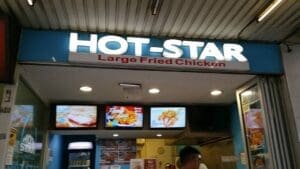
Hot-Star Large Fried Chicken started as a night market stall in Taipei in 1992, serving oversized, crispy chicken that became a global hit. By 2026, Hot-Star led Australia’s Taiwanese street food sector with compact, takeaway-focused outlets and a simple menu built around its signature fried chicken.
Its unique, fresh product and efficient real estate model fueled rapid growth in high-traffic areas, despite heavy competition. For owner-operators, Hot-Star offered a low-overhead, high-foot-traffic business—proving the power of simplicity and strong brand appeal.
2026 Hot-Star Australia: Growth Statistics & Performance
- Current Network Size: Over 25 operational store locations positioned across major Australian multicultural hubs, with heavily concentrated, high-performing clusters throughout Victoria, New South Wales, the ACT, and Queensland.
- Velocity/Targets: Shifting into active development pipelines targeting high-density transit interchanges and premium metropolitan shopping strips. The corporate expansion strategy focuses on securing high-volume, late-night high-street real estate to capture the lucrative evening convenience demographic.
- Operational Data: Driven by an exceptionally fast turnaround-of-service model that processes orders in minutes. Individual locations leverage massive-volume capabilities, and because their signature oversized chickens are naturally suited for takeaway packaging, delivery aggregator channels and walk-up orders account for the overwhelming majority of weekly transaction revenue.
Hot-Star Large Fried Chicken Executive & Industry Insights
“Hot-Star’s ongoing operational edge lies in its absolute product simplicity. By anchoring a global brand around a single, masterfully executed core item, the system completely bypasses the menu complexity, multi-ingredient spoilage risks, and heavy inventory tracking issues that plague multi-concept fast-food kitchens.” — Retail Market Summary, QSR Industry Intelligence.
“The commercial brilliance of the Taiwanese street food model is its high transaction density. Compact retail configurations that eliminate customer dining tables achieve maximum revenue per square metre, allowing operators to confidently absorb rising inner-city commercial rents.” — NoBullEconomics, Restaurant Research Analysis Report (May 2026)
Hot-Star Franchise Investment Snapshot Table
| Metric | Details |
Initial Investment | $250,000 to $450,000 AUD (Highly site-dependent, sitting as one of the lowest capital food options due to minimal shop footprints and streamlined commercial kitchen specs) |
Upfront Franchise Fee | Detailed upon formal candidate screening (Standardized baseline initial entry license fee for localised territory allocation) |
Ongoing Fees | Variable Structure (Comprising ongoing system maintenance fees, supply logistics contributions, and national brand advertising funds calculated against gross monthly store sales) |
Store Formats | Compact high-street walk-up shopfronts, shopping centre food court pods, and high-velocity transport hub kiosks |
Target Markets / Key Expansion Zones | Prime metropolitan high-traffic retail blocks, expanding multicultural suburban strips, and major university transit corridors |
Training & Support | Comprehensive operational onboarding program covering authentic Taiwanese hand-breading techniques, strict HACCP and ISO 22000 food safety certifications, inventory stock control, and local digital optimisation |
Franchise Comparison: HOT-STAR vs. NeNe Chicken vs. Gami Chicken vs. KFC
| Metric | Hot-Star | NeNe Chicken | Gami Chicken | KFC Australia |
Initial Investment | $250K – $450K | $400K – $700K | $400K – $650K | $1.5M – $3.0M+ |
Royalty Fee | Variable | 6% | 6% | 6% |
Marketing Fee | Variable | 3% | 2% – 3% | 5% – 6% |
Total Ongoing Fees | Highly Competitive | 9% | 8% – 9% average | ~11% – 12% average |
Australian Footprint | 25+ units | 40+ units | ~40+ units | 700+ units |
Primary Advantage | Micro-footprint & zero dining overhead | Rapid Korean fried sauce scaling | Social beer & shared dining model | Absolute mainstream brand dominance |
Key Insights
For a prospective food service buyer, Hot-Star Large Fried Chicken distinguishes itself through an exceptionally lean, asset-light business model. Its comparatively lower entry cost ($250k–$450k) than full-scale dining restaurants enables faster capital recovery and reduced financial exposure.
This operational efficiency is further enhanced by the brand’s highly focused menu, which streamlines supply chain management and labour requirements, and its micro-footprint store design, which minimises overheads related to real estate and in-store facilities.
Collectively, these advantages create a cleaner pathway to net margin preservation and position Hot-Star as a compelling alternative to competitors burdened by higher fixed costs and complex operational models.
When operators analyse the highly competitive fast-food and fried chicken landscapes, they weigh infrastructure scale against target demographic dining habits:
- For High-Velocity Korean Glazed Sauces: NeNe Chicken (~40+ stores) represents a powerful alternative format in the Asian chicken sector, leveraging a diverse variety of signature wet sauces and strong mall food-court placement to attract a highly tech-driven youth audience.
- For a Sit-Down, Evening Hospitality Focus: Gami Chicken (~40+ stores) targets a highly social, shared-dining evening demographic by combining premium Korean fried whole chicken plates with boutique tap beer, capturing high table dwell times over rapid transit takeaway.
- For Tier-One Mainstream Market Supremacy: KFC Australia (700+ stores) remains the ultimate blue-chip benchmark for volume-driven driveway traffic, commanding immense multi-generational customer flow at the expense of a massive, multi-million-dollar capital infrastructure layer ($1.5M – $3.0M+).
The Monkish Verdict
For the execution-focused owner-operator or retail group seeking entry into high-density urban nodes, Hot-Star Large Fried Chicken represents an exceptionally sharp, high-volume asset class perfectly optimised for modern grab-and-go real estate dynamics.
The primary operational barrier to master is localised crowd management and high peak-period labour throughput: because the brand builds its entire consumer draw on delivering blistering hot, freshly hand-breaded items straight from the fryers, managers must maintain perfect order-line coordination to prevent sidewalk blockages during intensive lunch and late-night surges.
For example, a store located on a busy city street may experience queues that extend outside the premises during lunchtime, requiring staff to efficiently process orders while guiding patrons to ensure public walkways remain accessible. Furthermore, because the menu is famously streamlined, maintaining flawless quality control across secondary snack lines is essential to maximise average ticket values.
However, the upside remains immensely profitable.
Supported by a highly distinctive, internationally recognised street-food cult status, a centralised supply network that ships fresh daily poultry free from preservatives, and a lean physical footprint that strips out the crushing financial burdens of maintaining customer dining facilities, Hot-Star stands as an exceptionally secure, high-velocity cash-flow machine in the competitive Australian QSR market.
Sources & Reference Material