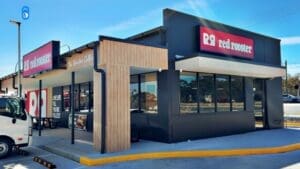
Red Rooster anchors Australia’s quick-service chicken market as a legacy powerhouse, blending long-standing brand heritage with a modernised, social-first growth strategy.
It remains a primary contender for multi-unit operators looking for an iconic, high-volume franchise model supported by a sophisticated national supply chain.
In 2026, the brand is undergoing a high-profile “social-dominant” transformation, shifting away from traditional, polished broadcasting to platform-native, creator-led engagement. (source: mediaweek)
This move is designed to recapture younger demographics and drive system-wide relevance while maintaining the brand’s core value proposition of affordable, hearty meals.
Franchisees in 2026 benefit from high-level brand awareness and a robust delivery and drive-thru infrastructure, but must navigate a competitive QSR environment and manage the operational complexity inherent in a dual roast-and-fry product model.
Initial investment costs ($400,000–$800,000) are substantial, requiring operators to prioritise high-traffic, strategically selected sites to optimise returns.
Brand Pedigree & Market Position
Founded in 1972 in Kelmscott, Western Australia, Red Rooster has evolved from a local rotisserie shop into one of Australia’s most recognisable fast-food icons.
Owned by Craveable Brands (backed by PAG Asia Capital), it leverages deep market penetration and a vast network of over 360 locations.
Its edge: A versatile menu that successfully balances the traditional “roast chicken” category with a competitive fried chicken and convenience-focused offering.
This dual-product versatility allows Red Rooster to capture diverse dayparts, from family-focused evening meals to high-speed lunch trade.
Red Rooster dominates suburban arterial roads and neighbourhood shopping centres, utilising a proven drive-thru and delivery-optimised layout that remains resilient against shifting retail trends.
2026 Red Rooster Australia: Growth Statistics & Performance
-
Current Network Size: Approximately 360+ store locations operating across Australia, with the strongest footprint across New South Wales, Queensland, and Western Australia.
-
Velocity/Targets: The brand is executing a “social-dominant” 2026 roadmap, partnering with creative agency Kill Boring Dead to shift media spending toward TikTok, Reels, and influencer-led content to drive ROI and store-level traffic.
-
Operational Data: Performance is bolstered by an established delivery platform and a high-efficiency drive-thru model. Franchisees are currently focused on maximising margins by balancing labour-intensive fresh prep with high-volume, quick-serve product throughput.
Red Rooster Executive & Industry Insights
“Australia’s original chicken shop is officially done playing it safe. This partnership [with Kill Boring Dead] is about backing creativity, embracing risk, and showing up in a way that feels real, not rehearsed.” — Sam Bragg, CEO of Red Rooster (Jan 2026)
“The brand’s pivot to platform-native, culturally driven social content is a calculated play to move beyond the promo-driven messaging that defines the category. By treating social as a core brand platform rather than a downstream distribution tool, Red Rooster is positioning itself to own a larger share of the younger consumer’s attention.” — Retail Market Summary, QSR Industry Intelligence (2026)
Red Rooster Franchise Investment Snapshot Table
| Metric |
Details |
| Initial Investment |
$400,000 to $800,000 + GST |
| Upfront Franchise Fee |
~$50,000 + GST |
| Ongoing Fees |
~11% total ongoing operational load |
| Store Formats |
Free-standing drive-thru, suburban strip, and shopping centre food courts |
| Target Markets |
High-growth metropolitan corridors and regional hubs |
| Training & Support |
Comprehensive induction covering workflows, kitchen management, and local social-marketing |
Franchise Comparison: RED ROOSTER vs. Oporto vs. KFC vs. Nando’s
| Metric |
Red Rooster |
Oporto |
KFC |
Nando’s |
| Initial Investment |
$400K – $800K |
$450K – $750K |
$1.5M – $2.5M |
~$600K+ |
| Total Ongoing Fees |
~11.0% |
~9.0% |
~9.0% |
~12.5% |
| Primary Advantage |
High brand legacy |
Flame-grilled focus |
Global scale |
Fast-casual appeal |
Key Insights
-
For Capital-Efficient Entry: Red Rooster’s established infrastructure and mid-range investment profile offer a more accessible entry than the heavy capital requirements of global giants like KFC.
-
For Operational Focus: The dual-product model requires high-level kitchen management to balance peak-hour demand for both rotisserie and deep-fried items.
-
Competitive Landscape: The 11% investment reflects a premium for national marketing reach and the aggressive new strategy.
The Monkish Verdict
Red Rooster presents a resilient asset for operators seeking a brand with deep cultural roots and a refreshed marketing roadmap.
The primary operational hurdle remains precise kitchen scheduling to manage its multi-category menu.
However, for an investor capable of capitalising on the brand’s high-traffic drive-thru footprint and modernised content strategy, it remains a cornerstone of the Australian QSR sector.
Sources & Reference Material