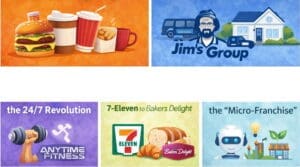
Australia holds a world-class reputation for its entrepreneurial spirit, and one statistic truly sets it apart: we are the most franchised nation per capita on the planet.
As we navigate through 2026, the franchise sector has grown into a powerhouse, contributing over $200 billion to the national economy and directly employing more than 600,000 Australians. That figure has grown steadily year-on-year, even as rising interest rates and cost-of-living pressures have squeezed other parts of the economy (Source:
IBISWorld – Franchising in Australia |
Haarsma – Franchising Update 2026).
For many Australians, the “Aussie Dream” has shifted from simply owning a home to owning a proven business system that offers a safety net in an increasingly complex financial landscape.
The appeal is understandable: a franchise gives you the independence to run your own business while benefiting from an established brand, a ready-made customer base, and operational playbooks refined over decades.
But what does it actually mean to be the “biggest” franchise in Australia?
Size can be a deceptive metric.
To a real estate mogul, it might mean the brand with the most valuable land holdings; to a private equity firm, it’s all about annual revenue; but to the average Australian walking down a suburban high street, it is about visibility and footprint.
Whether it’s the green-and-yellow logo of a sandwich shop or a white trailer parked in a neighbour’s driveway, these giants have become the background characters of our daily lives.
The landscape is currently dominated by a mix of American imports,
Franchises like KFC that have been “Aussiefied” over decades and homegrown legends that have successfully exported the Australian way of doing business worldwide.
Understanding this hierarchy is vital for investors and consumers alike.
As we analyse the data for 2026, we see a fascinating tension between the old guard of fast food and a surging “services” sector that prioritises convenience and lifestyle over calories.
Let’s peel back the curtain on the brands that truly own the Australian market today.
| 1 | Jim’s Group | Multi-Service | 5,700+ | Aggressive |
| 2 | Subway | Fast Food (Sandwiches) | 1,249 | Stable |
| 3 | McDonald’s | Fast Food (Burgers) | 1,073 | High Revenue |
| 4 | KFC | Fast Food (Chicken) | 806 | Steady |
| 5 | Anytime Fitness | Fitness/Gyms | 575 | Rapid |
| 6 | Bakers Delight | Retail Bakery | 565 | Localized |
| 7 | 7-Eleven | Convenience | 520 | Suburban Focus |
| 8 | The Coffee Club | Cafe/Dining | 325 | Regional |
| 9 | Boost Juice | Juice/Smoothies | 370 | Kiosk Growth |
| 10 | Red Rooster | Fast Food (Chicken) | 325 | Re-branding |
The Unstoppable Footprint: Food and Beverage Kings
Their success is largely attributed to a “low-barrier” model — Subway stores don’t require the massive drive-thru real estate or complex kitchen ventilation that their competitors do, allowing them to tuck into petrol stations, airports, and small rural strips.
Entry costs for a Subway franchise typically range from $250,000 to $400,000, making it one of the more accessible QSR options for first-time franchisees.
However, store count doesn’t tell the whole story.
In 2026, the average “Macca’s” unit generates significantly higher turnover than almost any other franchise model.
Their dominance is fueled by a massive push into digital integration, with over 80% of orders now flowing through the MyMacca’s app or in-store kiosks.
Following closely is KFC, which has expanded its footprint to 806 stores, capitalising on a dedicated Australian “cult” following that sees Australia as one of its most profitable global markets.
The Homegrown Legend: The Jim’s Group Phenomenon
You cannot discuss Australian franchising without mentioning the Jim’s Group.
While it isn’t a single food chain, it is arguably the most recognisable franchise brand in the country.
This year, the group has surpassed 5,700 franchisees across more than 50 different divisions.
This model is uniquely Australian: it takes a single, trusted face — Jim Penman — and applies it to everything from lawn mowing and cleaning to more modern niches like building inspections and drone services. (
jims.net – Which Division to Choose |
Jim Penman’s site).
The brilliance of Jim’s model lies in its “Division” structure.
Jim’s Mowing alone accounts for over 2,000 franchisees, making it larger than Subway and McDonald’s combined in terms of individual business owners.
In 2026, the group focused heavily on AI-driven lead generation, ensuring its massive fleet of white trailers remained never idle.
The Fitness Boom: Anytime Fitness and the 24/7 Revolution
The health and wellness sector has seen the most aggressive growth of any franchise category over the last five years.
Anytime Fitness leads with over 575 franchise clubs nationwide, giving franchisees access to a global network of 5,000+ clubs, shared technology, and bulk purchasing power that independent gym owners can’t match.
In a country that values lifestyle but works long hours, the 24/7 convenience gym has become a suburban staple.
Boutique functional franchises like F45 and BFT are also on the rise — with fewer locations, higher membership fees, and lower equipment overhead.
And watching closely from the wings: wellness franchises built around infrared saunas, cryotherapy, and contrast bathing, as Australians shift their focus from fitness to longevity.
Convenience and Local Staples: 7-Eleven to Bakers’ Delight
Retail franchising in Australia is anchored by two giants, each very different.
7-Eleven dominates the convenience and fuel space, acting as a high-frequency touchpoint for millions of commuters.
Meanwhile, Bakers Delight remains a powerhouse of the Australian shopping strip. With over 500 locations, it has maintained its “local bakery” feel despite being a massive corporate machine.
The success of these brands in 2026 stems from their ability to adapt to the “15-minute city” trend.
Australians are increasingly shopping hyper-locally, and franchises like Bakers Delight and Boost Juice (which holds 370+ locations) have mastered the art of the high-footfall “kiosk” or small-format store.
These brands prove that you don’t need a 500-square-meter footprint to be a “biggest” player; you just need to be exactly where the customer is when they realise they’re hungry or thirsty.
Emerging Trends: AI, Sustainability, and the “Micro-Franchise”
Looking at the data for 2026, the fastest-growing segment isn’t the million-dollar burger joint; it’s the Micro-Franchise. Banks and lenders have taken notice too, with several major institutions now offering tailored small-business loan products specifically designed for sub-$100,000 franchise entries — a structural shift that is dramatically lowering the barrier to ownership.
These are
low-cost franchise entries (often under $50,000) that focus on specialised services.
Brands like Young Engineers (STEM education) and Petbarn Mobile Dog Wash are exploding because they offer high ROI with minimal overhead.
Furthermore, 2026 has seen a “Green Shift.” Franchises that specialise in solar panel cleaning, EV charger maintenance, and waste reduction are the new “Gold Rush” of the sector.
The “biggest” franchises of the future are currently being built in these ESG-focused niches.
New Challengers: Overseas Brands Entering the Australian Market
The franchise landscape is not just being reshaped from within — international brands are circling.
The most
high-profile arrival is Jollibee, Asia’s largest fast-food chain, which is making its long-awaited Australian debut. After years of planning, the Philippine fast-food giant is moving closer to launching in Australia, with plans lodged for its first outlet in Campbelltown, Sydney
developed in partnership with PMG Group on a site that will also house Taco Bell and Krispy Kreme.
With over 10,000 restaurants globally across 19 brands, Jollibee Foods Corporation is not just opening a chicken shop — it is deploying a multi-billion-dollar capital strategy to challenge the entrenched dominance of KFC and McDonald’s in Australia (Source:
Inside Retail Australia).
Given the large Filipino population in Australia, particularly in Campbelltown, this entry is long overdue. Jollibee’s “diaspora-first” rollout strategy — targeting communities before the mainstream — is a playbook other international brands will be watching closely.
Conclusion
The Australian franchise landscape in 2026 is a testament to the sector’s incredible resilience and adaptability.
While the “Big Three” — Subway, McDonald’s, and KFC — continue to define our suburban skylines and set the standard for operational excellence, the real story of 2026 is the market’s diversification.
A decade ago, “franchise” was almost synonymous with fast food.
Today, you are just as likely to encounter a franchise model behind your physiotherapist, your dog groomer, or the technician servicing your solar panels.
From the massive service network of the Jim’s Group to the high-tech wellness hubs popping up in our CBDs, franchising has proven it can scale almost any idea if the systems are robust enough.
For a potential investor, the “biggest” franchise is no longer just the one with the most stores; it is the one that best aligns with the shifting lifestyle demands of the modern Australian.
As we look toward the 2030s, expect these giants to continue evolving, proving that in the world of Australian business, the system is indeed the solution.