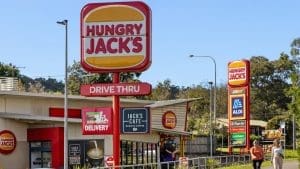
Hungry Jack’s dominates Australia’s QSR burger sector with a massive network of locations, according to the sources cited here, serving as a premium option for experienced operators due to its high-volume, corporate-backed framework.
Now, amid a major push into digital ecosystems and menu diversification, Hungry Jack’s Australia is expanding its non-traditional footprint and upgrading existing store formats to appeal to prospective franchisees facing rising competition from premium fast-casual burger brands.
For potential franchisees in 2026, investing offers exceptional brand recognition and robust corporate infrastructure, but it also entails challenges such as steep initial capital requirements and a competitive premium market.
Hungry Jack’s was founded in 1971 by Jack Cowin in Innaloo, Perth, operating as the exclusive master franchisee of Burger King Corporation in Australia, according to the history profile cited here.
The distinct branding arose because the “Burger King” trademark was already registered by a local food shop in Adelaide.
Its competitive advantage stems from the structural weight of its global product pipeline—headlined by the iconic flame-grilled Whopper—pioneering heavy-volume, flame-broiled fast food in Australia, according to the brand strategy sources cited here.
By focusing on flame-grilling rather than frying patties, Hungry Jack’s established a distinct market position.
In Australia, its main advantages are its institutional-grade drive-thru presence, a strong regional footprint via its parent company, Competitive Foods Australia, and the ability to anchor premium highway service centres and suburban thoroughfares where high vehicular traffic is guaranteed.
2026 Hungry Jack’s Australia: Growth Statistics & Performance
- Current Network Size: Over 450 stores across Australia, maintaining a strong top-tier market presence alongside McDonald’s and KFC.
- Velocity/Targets: Focuses on high-margin asset optimisation. Growth is strictly targeted toward modern drive-thru corridors, regional infill towns, and non-traditional fuel/convenience hub integrations. System-wide sales across the broader Competitive Foods portfolio exceed $2 billion annually.
- Operational Data: Average annual revenue per store ranges from $3,500,000 to $4,500,000+ AUD for mature drive-thru locations. Digital orders via the Hungry Jack’s App and delivery aggregators account for 35–40% of total store revenue, helping protect gross margins against inflationary food costs.
Hungry Jack’s Executive & Industry Insights
“Hungry Jack’s continues to leverage its corporate agility under Competitive Foods Australia. The master franchise structure allows it to react faster to local supply chain pressures than many globally managed brands, though balancing steep capital expenditure for drive-thru fit-outs with rising labour costs remains an operational priority.” — NoBullEconomics, Restaurant Research Analysis Report (May 2026)
“The brand’s primary modern strength lies in its digital ecosystem. By pairing aggressive app-based gamification with deep value promotions, they have successfully sustained transactional volume while their premium menu tiers protect individual store margins from eroding.” — Retail Market Summary, QSR Industry Intelligence.
Hungry Jack’s Franchise Investment Snapshot Table
| Metric | Details |
Initial Investment | $1,500,000 to $3,000,000+ AUD (High-tier entry cost heavily dependent on civil works, drive-thru lanes, and specialized equipment layouts) |
Upfront Franchise Fee | ~$60,000 AUD (Reflective of a premium, blue-chip tier international brand system) |
Ongoing Fees | 9% to 11% of gross sales (Typically consisting of a 5% royalty fee and a 4% to 6% marketing/advertising levy, plus variable base rent structures) |
Store Formats | Free-standing drive-thrus, inline high-street configurations, food courts, and integrated highway travel plazas |
Target Markets / Key Expansion Zones | Outer metropolitan transport corridors, high-density regional bypasses, and select fuel-network co-locations |
Training & Support | Comprehensive, hands-on operational training program (often requiring up to 12 months for new operators) covering multi-site management, supply chain logistics, and digital platform deployment |
Franchise Comparison: HUNGRY JACK’S vs. Grill’d vs. Betty’s Burgers vs. Carl’s Jr.
| Metric | Hungry Jack’s | Grill’d | Betty’s Burgers | Carl’s Jr. |
Initial Investment | $1.5M – $3.0M+ | $555K – $885K | $750K – $1.2M+ | $1.2M – $2.5M |
Royalty Fee | 5% | Variable (TBC) | Corporate/Variable | 5% |
Marketing Fee | 4% – 6% | Variable (TBC) | Corporate/Variable | 4.5% |
Total Ongoing Fees | 9% – 11% | ~10% est. | Corporate Managed | 9.5% |
Australian Footprint | 450+ units | ~170 units | ~60+ units | ~40+ units |
Primary Advantage | High-volume drive-thru infrastructure | Healthy, premium burger market share | Highly localised, trendy beach-shack aesthetic | Massive international product pipeline |
Key Insights
For a prospective Australian franchise buyer, Hungry Jack’s offers significant revenue potential and highly mature corporate systems, but it demands an exceptionally high upfront capital investment ($1.5M–$3.0M+) and rigorous, full-time operational screening.
When buyers cross-shop high-volume burger brands, they balance the massive customer draw of a drive-thru against the lighter setup requirements and trendy brand positioning of fast-casual spaces:
- For Premium Foot-Traffic Control: Grill’d (~170 stores) targets the conscious consumer market with a smaller physical footprint, bypassing heavy drive-thru real estate costs while capturing premium, higher-margin dinner traffic.
- For High-End Visual Appeal & Margins: Betty’s Burgers commands an elevated, premium aesthetic that permits higher average transaction values from younger demographics, mitigating the strict value-menu margin squeezes seen in traditional fast food.
- For Alternative Drive-Thru Scale: Carl’s Jr. provides an alternative pathway for operators seeking drive-thru dominance in specific expansion territories where Hungry Jack’s or McDonald’s territories are completely locked out.
The Monkish Verdict
For institutional groups or high-net-worth operators, Hungry Jack’s Australia represents a premium, recession-resistant asset class with immense top-line revenue potential.
The primary operational barrier is the steep financial and personal barrier to entry: a multi-million-dollar capital outlay combined with mandatory, intensive operational validation makes it unsuitable for passive investors.
Furthermore, managing low-margin value promotions alongside an aggressive corporate-mandated digital discount strategy requires a highly experienced operator to prevent bottom-line erosion.
However, the upside lies in its undeniable volume. Backed by the supply chain power of Competitive Foods Australia and a permanent piece of the Australian highway landscape, Hungry Jack’s functions as a highly scalable, institutional-grade cash-flow engine if you possess the capital to access the tier.
Sources & Reference Material